
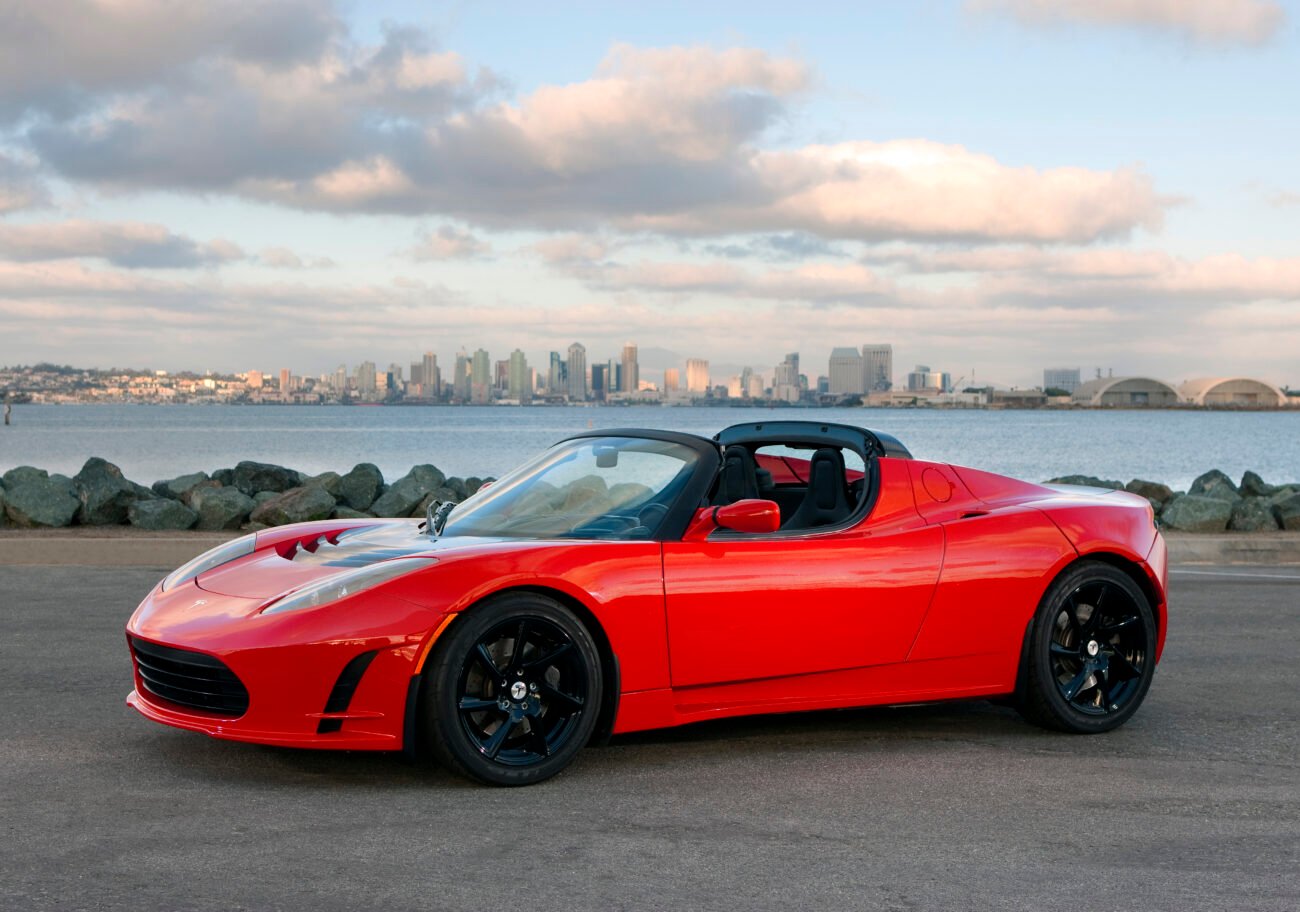
The Tesla Roadster 2008 was more than an unusual electric sports car. It was a bold experiment that helped convince the automotive industry that battery power could deliver serious performance. When the Roadster arrived, electric vehicles were still widely associated with limited range, modest acceleration, and practical city driving. Tesla took a very different approach: build a lightweight sports car capable of delivering rapid acceleration while using a large lithium-ion battery pack.
Today, the original Roadster remains one of the most important vehicles in modern automotive history. It introduced Tesla to customers, demonstrated the potential of lithium-ion technology in a production car, and established a performance-focused identity that would later influence the company’s future vehicles.
What Made the Tesla Roadster 2008 Special?
The Tesla Roadster 2008 was based heavily on the Lotus Elise platform, but its mechanical heart was completely different. Instead of a conventional gasoline engine, Tesla installed an electric powertrain and a large battery system.
This combination created an unusual sports car. The exterior had the compact proportions and low-slung appearance associated with Lotus, while the technology underneath was designed around electric propulsion.
The Roadster showed that an electric car did not necessarily have to sacrifice excitement for efficiency. Tesla’s first production vehicle could accelerate strongly, handle like a sports car, and travel considerably farther between charges than many electric vehicles available at the time.
The original Roadster produced around 248 horsepower and 276 lb-ft of torque, with rear-wheel drive and a single-speed transmission. Its lightweight construction also played an important role in its performance.
Performance That Surprised Enthusiasts
Performance was arguably the biggest reason the original Roadster attracted attention.
Tesla stated that the Roadster could accelerate from 0 to 60 mph in approximately 3.9 seconds and reach a top speed of about 120 mph. The later Roadster Sport improved acceleration even further, making the electric sports car considerably quicker.
Those figures were remarkable for an electric vehicle in the late 2000s. More importantly, the driving experience demonstrated one of the fundamental advantages of electric propulsion: immediate response.
Unlike a traditional gasoline engine that builds power through a transmission and rising engine speed, an electric motor can deliver substantial torque almost instantly. This gave the Roadster a distinctive character that drivers could feel immediately when pressing the accelerator.
Independent road testing also demonstrated that the car could deliver impressive acceleration under suitable conditions. Results naturally varied depending on weather, road surface, battery condition, tires, and testing methods.
A Battery Unlike Most Cars of Its Era
One of the most interesting aspects of the original Roadster was its battery.
Tesla used thousands of relatively small lithium-ion cells rather than relying on a handful of very large cells. The Roadster battery system contained thousands of individual cells arranged into groups and carefully monitored for voltage and temperature.
This architecture was ambitious for its time. Temperature management was particularly important because battery performance and longevity depend heavily on controlling heat.
The battery pack stored roughly 56 kWh of energy in its original configuration. It was also extremely heavy compared with modern battery technology, making weight distribution and chassis engineering especially important.
Despite its weight, Tesla managed to create a sports car that remained relatively light compared with many conventional performance vehicles.
Range Was a Major Achievement
Range was another area where the Roadster challenged expectations.
Tesla ultimately reported an EPA-tested range of approximately 245 miles for the Roadster. At the time, that was a striking figure for a production electric vehicle, particularly one designed as a performance car rather than a small commuter.
Real-world range can vary significantly. Temperature, driving speed, road conditions, battery age, tire condition, and climate-control use all influence how far an older electric vehicle can travel on a charge.
The Roadster’s range was particularly impressive because it arrived before today’s widespread fast-charging networks and advanced battery technology had become common.
For modern drivers accustomed to rapid charging and sophisticated battery systems, the Roadster’s charging experience can seem basic. Yet its ability to offer long-distance capability at all was one of its defining achievements.
The Lotus Connection
The Roadster’s relationship with Lotus is central to understanding its design.
Tesla used the Lotus Elise as the foundation for its first production vehicle, benefiting from the Elise’s lightweight sports-car architecture and handling characteristics. However, converting that platform to electric power was far from a simple engine swap.
The gasoline engine and related mechanical components were replaced with an electric motor, battery system, electronics, and associated cooling hardware.
The result retained the visual character of a lightweight British sports car while introducing an entirely new powertrain philosophy.
That combination gave the Roadster a distinctive personality. It was recognizable as a small sports car, but its driving behavior reflected the immediate response of an electric motor.
Inside the 2008 Roadster
The cabin was deliberately compact and focused on the driving experience.
The 2008 Roadster was a two-seat convertible with sport-oriented seats and a driver-focused interior. Its equipment included features such as air conditioning, power windows, leather-trimmed elements, and an information display.
It was never intended to compete with a large luxury sedan for interior space. Instead, the Roadster offered a minimalist sports-car environment.
The compact cabin reinforced the car’s character. It felt closer to a specialized weekend sports car than a conventional family vehicle.
This was an important part of Tesla’s early strategy. Rather than trying to create an electric family car immediately, the company used a desirable sports car to demonstrate what electric technology could accomplish.
Why the Roadster Became Historically Important
The greatest achievement of the Tesla Roadster 2008 may not be any individual specification.
Its importance came from proving a concept.
Before Tesla, electric cars had already existed in different forms, but the Roadster helped change the conversation surrounding electric performance. It showed consumers that an electric vehicle could be desirable because of its performance rather than merely acceptable because of environmental benefits.
Tesla eventually delivered more than 2,000 Roadsters to customers around the world before production ended in 2012.
That relatively small production volume makes the original Roadster especially interesting today. It was never a mass-market automobile, but its influence reached far beyond its sales numbers.
Is the 2008 Roadster Still Interesting Today?
Absolutely, although owning one today requires a different mindset from buying a conventional used sports car.
Age is an important factor. Battery condition, replacement parts, electronics, charging equipment, tires, suspension components, and other systems deserve careful inspection.
The Roadster is also a specialized vehicle. A prospective owner should understand its history and carefully evaluate the condition of the individual example rather than relying solely on the original specifications.
Battery health is particularly important. An older battery may behave very differently from the battery when the vehicle was new, and replacement or refurbishment can be a significant consideration.
For collectors and enthusiasts, originality and documented history can also be meaningful because early Roadsters occupy an important place in Tesla’s development.
Tesla Roadster 2008 vs. Modern Electric Cars
Comparing the original Roadster with today’s electric vehicles reveals just how quickly technology has advanced.
Modern EVs generally offer more sophisticated driver assistance, larger displays, faster charging infrastructure, improved battery management, stronger safety technology, and substantially more refined interiors.
Yet the Roadster retains something that specifications alone cannot capture: historical significance.
Modern electric cars exist in a world where battery-powered performance is no longer surprising. The Roadster helped create that world.
A Pioneer With Lasting Influence
The Tesla Roadster 2008 was not perfect, and it was never designed to be a practical vehicle for everyone. Its small cabin, limited production, specialized technology, and early-generation battery system made it a niche product.
But pioneers rarely need to be perfect.
The Roadster demonstrated that electric propulsion could coexist with speed, style, and excitement. That lesson became central to Tesla’s later vehicles and helped influence how other manufacturers approached electric performance.
Frequently Asked Questions
What was the range of the 2008 Tesla Roadster?
The Roadster was eventually rated at approximately 245 miles of EPA range. Actual range can vary depending on driving conditions, weather, battery age, and vehicle condition.
How fast was the 2008 Tesla Roadster?
The original Roadster was capable of reaching 60 mph in roughly 3.9 seconds, with a top speed of approximately 120 mph.
How many battery cells did the Roadster have?
The Roadster used thousands of individual lithium-ion cells. Its battery system was designed around extensive monitoring of cell voltage and temperature.
Was the 2008 Roadster based on a Lotus?
Yes. The Roadster used the Lotus Elise as the foundation for its lightweight sports-car architecture, while Tesla developed the electric powertrain and battery system.
Is the original Roadster important to Tesla’s history?
Yes. It was Tesla’s first production vehicle and demonstrated that a battery-powered car could deliver serious sports-car performance and meaningful driving range.
Conclusion
The Tesla Roadster 2008 deserves its place among the most influential modern electric cars. It combined a lightweight sports-car platform with an innovative lithium-ion battery system and proved that electric propulsion could be exciting as well as efficient.
Its specifications may look modest beside today’s high-performance EVs, but judging the Roadster only by modern numbers misses its real achievement. At a time when electric cars were still searching for mainstream acceptance, this small two-seat sports car presented a completely different vision.
The original Roadster helped establish the idea that an electric vehicle could be desirable, fast, technologically ambitious, and genuinely fun to drive. More than a decade later, that basic idea remains one of its most enduring contributions to the automotive world.
